1. Circular Nickel, Power Batteries and Sustainability: The Outlook To 2050 For Nickel Mining, Refining and Recycling
The fast pace of development of the global battery industry, both commercial and technical, is making it very difficult to see where the nickel industry is headed. Reports published by the IEA predict that by 2040, demand for nickel will increase by a factor of between 6 and 19 relative to 2020, with enormous implications for the global nickel mining and refining industry. With such growth, how could the world ever attain a fully sustainable clean energy system?
These IEA scenarios do not go beyond 2040 and because of this they do not fully take into account the potential nickel supply from recycled batteries. EnerChemTek’s latest scenario analysis indicates that the demand for mined nickel actually peaks around 2037 and declines every year thereafter until full sustainability is achieved around 2050. Long term mined nickel supply returns to historical trend lines while battery recycling becomes the dominant source of Class 1 nickel. This scenario obviously has huge implications for strategic planning in the nickel mining, refining and recycling sectors, with many new opportunities emerging globally.
The results of EnerChemTek’s nickel scenario analysis are summarized graphically in the chart below.
EnerChemTek Nickel Supply/Demand Scenario to 2050
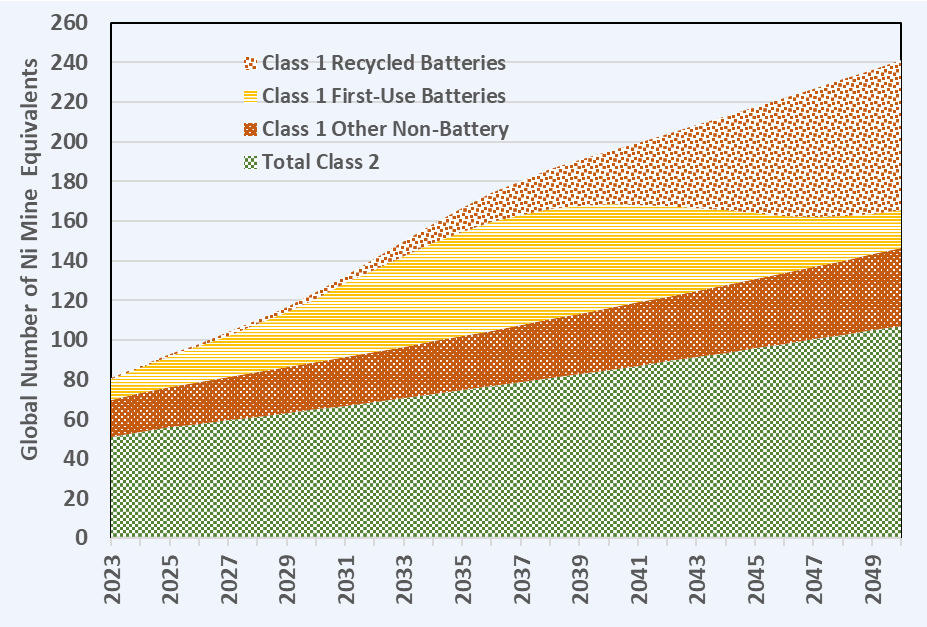
Note: One Ni mine equivalent = 40 kta Class 1 nickel
Source: EnerChemTek, Inc.
We invite you to subscribe to our new report on coming developments in the global nickel industry.
Click on the link below to download the brochure with The Table of Contents and front matter of the report which is attached for your consideration.
Circular Nickel, Power Batteries and Sustainability: The Outlook to 2050
If you have any questions or require further information please contact us by phone or by e-mail provided below:
Tel: (416) 232-0320
E-mail: mdavila@enerchemtek.com
2. Battery Grade Nickel: Sustainable Processing Options
Techno-Economic Comparisons of Leading Process for Recovery of Battery-Grade Nickel from Both Sulfide and Laterite Ores
The “Energy Transition,” driven by climate change agendas around the world, will require an enormous investment in battery energy storage, both to stabilize intermittent generation from renewables and to power the transition to electrified mobility. This stored energy will, in effect, replace the global inventory of fossil fuels currently held in reserve for peak load abatement, in refinery product storage tanks, and in the fuel tanks of the billions of cars and trucks on the road worldwide.
Nickel is the preferred metal for electric vehicle (EV) lithium-ion batteries (LiBs) with high energy storage density and good power characteristics. There are other metals used in LiBs such as manganese, cobalt, and iron, but nickel offers the best combination of performance and price.
This report provides six case studies of the primary options for extraction of battery grade nickel from sulfide (3 case studies) and laterite (3 case studies) ores that are directly comparable in terms of nickel output. The objective is to give prospective mine developers and investors the tools they need to assess the prospects for Class I nickel production from new mining and refining operations.
The report provides a deep understanding of all 6 Case Studies, including the following information:
- For each case study, a technoeconomic analysis of the case option including process flow sheet, process description, outline material & energy balances, variability analyses, effluent stream flows and analyses plus environmental penalties, and process strengths, weaknesses and future technology outlook.
- Capital investments and operating costs plus projected cash flows and profitability indicators.
- A basic pricing and inflation scenario with projected price indices for nickel, energy, chemicals & labor and plant construction, to be used throughout the study.
- An executive summary discussing the strengths, weaknesses and sustainability aspects of each of the 6 technologies and a ranking in terms of nickel production costs, return on investment and sustainability, based on analyses of the 6 individual technologies.
EnerChemTek (ECT) recognizes that metal extraction and refining technologies are complex, with many process variations due in large part to variations in ore compositions and morphology. There are also variations in the primary nickel product: Class I metal powders or pellets, battery grade nickel sulfate, battery grade nickel hydroxide or mixed Ni/Co hydroxide precipitate. Depending on subscriber needs and requests, therefore, ECT plans the future publication of supplementary studies & analyses covering specific variations in technologies & ores that will be directly comparable to the benchmarks developed in this current report.
These supplemental studies will be published under separate subscription either as variations of the individual technologies made available as separate reports, or as second (or 3rd) editions of the current 6-technology study.
Click on the link below to download the brochure
Battery Grade Nickel: Sustainable Processing Options
If you have any questions or require further information please contact us by phone or by e-mail provided below:
Tel: (416) 232-0320
E-mail: mdavila@enerchemtek.com